David Walker
Where'd You Go BernadetteDavid Walker is a contractor whose partnership with Bernadette Fox helped transform the former Beeber Bifocal factory into a home. He joined the project without conventional plans or permits, and his practical presence helped turn Fox’s commitment to reuse into a way of working: the materials already in the building would shape what the house became.
Identity and Introduction
Walker meets Fox at a dinner party soon after she and Elgin Branch buy the former factory. Over dessert, she asks him to be her contractor. He offers to provide references, but she says she simply likes him and asks him to come by that Saturday with some workers. Their arrangement begins less with a formal presentation than with her confidence in him and an immediate invitation to work.
Work on the Factory Conversion
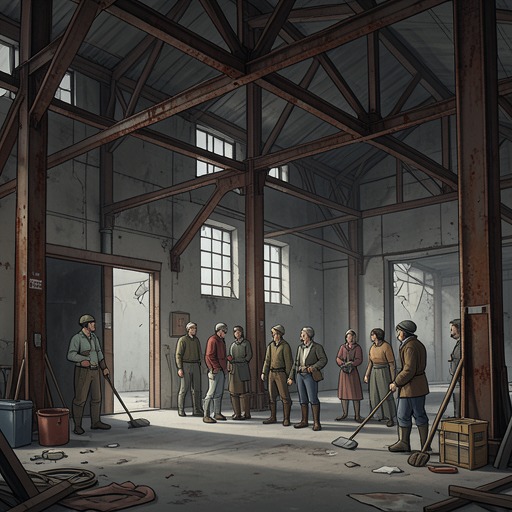
The building that Walker joined Fox in transforming was a three-thousand-square-foot cinder-block box, with eleven-foot ceilings, a clerestory, and a roof made up of skylights. The conversion occupied the next two years of Fox’s life, and Walker was there every day. At their first work session, Fox had no plans or permits ready. She had brought brooms and squeegees instead, and the group began by sweeping the floor and cleaning the windows and skylights. When Walker asked whether he should order a dumpster, Fox refused.
That refusal acquired practical meaning as Fox spent the following week laying out the building’s contents: thousands of bifocal frames, boxes of lenses, flattened cardboard, and the machinery used to cut and polish lenses. Walker recalls that the project soon became a game of avoiding trips to the hardware store and using only what was already on the premises. His account gives the reuse principle a daily, hands-on form: the factory’s discarded stock was not cleared away before design began, but became the material from which the design could grow.
Collaboration and Working Method
Walker’s role in the project was collaborative rather than simply supervisory. He arrived with workers when Fox asked, and helped establish the on-site process in which the building’s available materials set the limits and possibilities of construction. The project’s lack of conventional preparation did not prevent work from beginning; the first tasks were cleaning, sorting, and discovering what the factory itself could supply.
Walker’s recollection also makes the factory conversion distinct from a conventional build organized around purchases and a settled design. The refusal of a dumpster and the effort to avoid hardware-store runs turned restraint into a shared practice. In the available account, Walker is the contractor who helps make that practice workable: not by imposing a finished plan, but by showing up, bringing a crew, and building within the conditions Fox created.